
CATIA Course Scope: Career Uses in Product and Automotive Design
CATIA Course Scope: Career Uses in Product and Automotive Design The demand for skilled mechanical
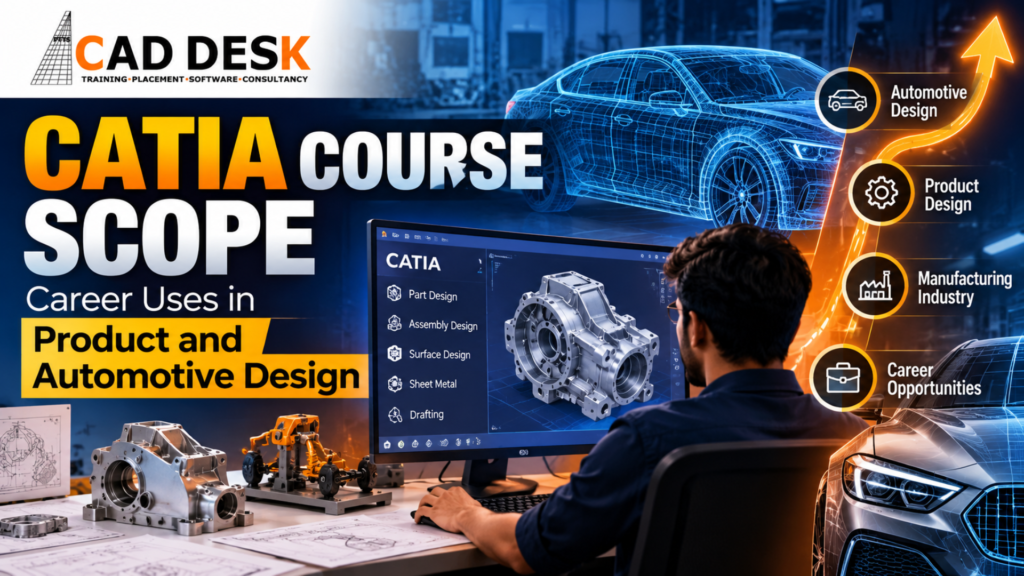
The demand for skilled mechanical design professionals is increasing as engineering companies continue to depend on digital design, 3D modeling, product development, and computer-aided engineering. For mechanical engineering students and graduates, learning an industry-used CAD platform can open opportunities in product design, automotive engineering, manufacturing, aerospace, and engineering services. A CATIA Course In Hyderabad can be a practical step for students who want to build skills beyond traditional engineering subjects and move toward design-oriented careers.CATIA is widely associated with complex product development, 3D modeling, assembly design, surface modeling, and engineering documentation. A CATIA Course In Hyderabad can help learners understand how a mechanical concept is converted into a detailed digital model and eventually into manufacturing-ready documentation. For students exploring CATIA training Hyderabad, the important point is that CATIA is not limited to simply creating attractive 3D models. It is used as part of broader product development workflows where accuracy, design intent, assembly relationships, and manufacturability matter.For mechanical students, the relevance becomes even clearer when looking at industries such as automotive and manufacturing. A CATIA Course In Hyderabad can introduce learners to the type of design work involved in creating vehicle components, machine parts, assemblies, fixtures, enclosures, and other engineered products. Students interested in CATIA for mechanical engineers can therefore use the software as a bridge between their engineering knowledge and practical CAD design skills.
CATIA is a computer-aided design and product development platform developed by Dassault Systèmes. It is used for designing products and engineering systems in three dimensions and supports different stages of product development. A CATIA Course In Hyderabad generally introduces students to the software environment before moving into sketching, part modeling, assembly design, drafting, and more advanced design areas.One of the important characteristics of CATIA is its ability to handle complex geometry and large product structures. A CATIA Course In Hyderabad can therefore be useful for students who want to work with designs that go beyond basic mechanical components. Depending on the training structure, learners may work with individual parts, assemblies, sheet metal components, wireframe geometry, surfaces, and engineering drawings.The software is particularly relevant to automotive and aerospace-related design environments, while its capabilities also apply to manufacturing and product development. For someone searching for CATIA training Hyderabad, understanding these different applications is important because the career value of the software depends not only on knowing commands but also on understanding where those commands are used in real design work.
The scope of CATIA for mechanical students is mainly connected to product design, mechanical modeling, automotive component development, assembly design, surface modeling, drafting, and manufacturing-related design documentation. A CATIA Course In Hyderabad can help students develop practical CAD skills that complement subjects such as engineering drawing, machine design, manufacturing processes, and mechanics.Students studying mechanical engineering already have an understanding of components, dimensions, materials, manufacturing methods, and engineering principles. A CATIA Course In Hyderabad allows them to apply some of this theoretical knowledge in a digital design environment. This combination can be useful when applying for entry-level roles such as CAD designer, mechanical design engineer, product design trainee, or CAD modeler.For students specifically interested in CATIA for mechanical engineers, the learning path can begin with basic sketching and gradually progress toward part modeling, assembly creation, surface development, and technical drawings. Developing these skills together is more useful than learning isolated commands because professional design work normally involves multiple stages.
Product design involves more than creating the external appearance of an object. Engineers need to consider dimensions, functionality, component relationships, manufacturing requirements, assembly methods, and design changes. A CATIA Course In Hyderabad can introduce students to this complete approach through 3D modeling and product development exercises.
For example, consider a mechanical product containing several individual components. Each component may need to be modeled separately before being combined into an assembly. A CATIA Course In Hyderabad can help learners understand how individual parts are created and then positioned using assembly relationships.
This approach is useful for students interested in product design because it encourages them to think about how components interact rather than viewing every model as an isolated object. This is one reason CATIA for mechanical engineers can be relevant for careers involving industrial products, machinery, automotive components, and engineered systems.
Automotive design is one of the major areas where CATIA has established applications. Vehicle development involves thousands of components and requires coordination between mechanical systems, body structures, interiors, manufacturing, and styling. A CATIA Course In Hyderabad can provide an introduction to the digital modeling techniques used when developing automotive components.
Automotive design also requires both mechanical accuracy and complex geometry. Components such as brackets, mounts, housings, panels, interior components, and structural parts may have different design requirements. A CATIA Course In Hyderabad can expose learners to the modeling approaches required for both relatively simple mechanical parts and more complex shapes.
Students researching automotive design CAD should understand that automotive engineering is not one single job. There are different areas including component design, body design, interior design, tooling, surface development, assembly, and manufacturing support. Learning CATIA can provide a foundation from which students can explore these different directions.
Automotive component design involves creating parts that need to fit accurately within larger vehicle assemblies. A CATIA Course In Hyderabad can help students understand how 3D part models are developed with dimensions, constraints, features, and design intent.
A simple automotive bracket, for example, may need mounting holes, bends, thickness requirements, and connections to other components. Through a CATIA Course In Hyderabad, students can practice creating such components and then placing them into assemblies.
This type of practice is particularly valuable for learners interested in CATIA for mechanical engineers because it connects CAD operations with actual engineering thinking. Instead of simply learning how to create a pad or pocket, students can understand why a particular feature is required and how it affects the final component.
Surface modeling is another important area that gives CATIA a wider career scope. Unlike basic solid modeling, surface modeling is often used for creating and controlling complex shapes. A CATIA Course In Hyderabad that includes surface modeling can be useful for learners interested in automotive body design, product styling, consumer products, and other applications involving curved geometry.
Automotive products frequently contain smooth transitions, curved panels, aerodynamic forms, and complex exterior surfaces. This is where automotive design CAD becomes more demanding than conventional mechanical drafting. Students who develop an understanding of wireframe and surface techniques can explore design areas where shape quality is particularly important.
Surface modeling can also be relevant outside automotive design. Product designers working on appliances, equipment housings, consumer products, and industrial components may encounter complex shapes that cannot be efficiently handled using only basic solid features. A CATIA Course In Hyderabad can introduce students to these concepts and help them build a stronger modeling foundation.
Product development usually involves several stages, from the initial concept to detailed design and manufacturing documentation. A CATIA Course In Hyderabad can help students understand how CAD fits into this larger process.
A designer may begin with a basic concept and create an initial 3D model. The design can then be refined by modifying dimensions, adding features, checking assembly relationships, and preparing drawings. A CATIA Course In Hyderabad can provide practical exercises that demonstrate how changes made to a component affect the overall model.
For CATIA for mechanical engineers, this parametric approach is particularly useful. Mechanical products frequently go through multiple design revisions. Engineers need to modify existing models without rebuilding everything from the beginning. Understanding design intent and feature relationships can therefore become an important part of professional CAD work.
Sheet metal design is another area that can be explored by mechanical engineering students. Sheet metal components are common in industrial equipment, automotive applications, enclosures, machinery, and fabricated products. A CATIA Course In Hyderabad that covers sheet metal can introduce students to bends, walls, flanges, unfolding, and related design concepts.
Understanding sheet metal design also requires awareness of manufacturing processes. A part may look correct in a 3D model but still require changes to make it practical for fabrication. Through CATIA training Hyderabad, students can learn to think about the relationship between the digital model and the manufacturing process.
This is particularly relevant for CATIA for mechanical engineers because mechanical design roles often require designers to consider how a component will actually be produced rather than focusing only on its appearance.
Learning CATIA does not automatically determine a particular career path, but it can support several CAD-related roles. A CATIA Course In Hyderabad can prepare students to explore positions such as mechanical CAD designer, product design engineer, CAD modeler, automotive design trainee, design engineer, surface designer, and drafting-related roles.
The exact job title and responsibilities vary between companies. A CATIA Course In Hyderabad may provide the software foundation, while employers can also expect knowledge of engineering drawing, manufacturing processes, GD&T, materials, and mechanical design principles.
Students interested in CATIA training Hyderabad should therefore avoid treating software knowledge as the only requirement. A stronger profile combines CATIA with engineering fundamentals, practical projects, communication skills, and an understanding of the design-to-manufacturing process.
CATIA becomes more valuable when combined with supporting engineering skills. A CATIA Course In Hyderabad can teach the software, but students should also strengthen their understanding of engineering drawing, geometric dimensioning and tolerancing, manufacturing processes, materials, and basic design calculations.
Knowledge of other CAD and engineering tools can also be useful depending on the career direction. However, students do not need to learn every available software package at once. A CATIA Course In Hyderabad can be treated as the main modeling skill while additional tools are added according to the target industry.
For learners interested in automotive design CAD, subjects such as vehicle components, manufacturing methods, sheet metal, plastics, surface modeling, and assembly design can complement CATIA knowledge.
For students looking for structured learning, Caddesk Hyderabad lists CATIA under its Mechanical CAD program. Its CATIA course information covers areas including sketching, part design, assembly design, surface modeling, sheet metal design, drafting, and product development workflows.A CATIA Course In Hyderabad at Caddesk Hyderabad can therefore be considered by mechanical engineering students, diploma holders, design aspirants, and professionals who want structured exposure to CATIA. The institute’s published course information describes practical exercises and project-based learning alongside the software curriculum.For learners searching specifically for CATIA training Hyderabad, Caddesk Hyderabad also presents CATIA as part of its broader Mechanical CAD training offering. Its published course listings include other mechanical CAD technologies such as AutoCAD Mechanical, Creo, NX CAD, SolidWorks, Ansys, and HyperMesh.The benefit of choosing a structured CATIA Course In Hyderabad is that learners can follow a sequence instead of trying to learn every feature independently. A planned progression from sketching to part modeling, assemblies, surfaces, and drawings can make the learning process easier to manage.
CATIA can initially appear complex because it contains many workbenches and tools. However, a CATIA Course In Hyderabad that starts with fundamental concepts can make the learning process more manageable.
Students do not need to master every workbench immediately. For CATIA for mechanical engineers, it is more practical to first become comfortable with sketching, constraints, part modeling, assemblies, and drafting. Once these foundations are strong, learners can move toward surface modeling and other specialized areas.
Regular practice is more important than trying to memorize every command. A student who spends time creating actual components will generally develop a better understanding of the software than someone who only watches demonstrations. This is why practical exercises should be an important part of CATIA training Hyderabad.
Yes, CATIA can be useful for mechanical engineering students who want to move into CAD and product development roles. A CATIA Course In Hyderabad can provide practical exposure to 3D modeling, assemblies, surfaces, and engineering documentation.
The software is particularly relevant for students interested in automotive, aerospace, product design, manufacturing, and mechanical engineering services. However, the value of the skill depends on the student’s ability to combine software knowledge with engineering fundamentals. CATIA for mechanical engineers should therefore be viewed as a professional design skill rather than a replacement for engineering knowledge.
Students should also consider the type of job they want before choosing advanced modules. Someone interested in automotive components may focus on part and assembly design, while someone interested in styling may spend more time learning surface modeling. A CATIA Course In Hyderabad can provide the base from which these specializations can be explored.
What is the scope of CATIA for mechanical students?
The scope of CATIA for mechanical students includes mechanical CAD, product design, automotive component design, assembly modeling, surface modeling, sheet metal design, engineering drawings, and product development. A CATIA Course In Hyderabad can help students build practical skills in these areas and understand how CATIA is used in engineering design workflows.
Is CATIA good for automotive design?
CATIA has applications in automotive design, particularly in areas involving complex 3D modeling, assemblies, surfaces, and product development. A CATIA Course In Hyderabad can help students interested in automotive design CAD understand the modeling techniques used for automotive components and product structures.
Is CATIA useful for mechanical engineers?
Yes. CATIA can be useful for mechanical engineers working toward CAD and product design careers. A CATIA Course In Hyderabad can help CATIA for mechanical engineers learners develop practical skills in part modeling, assembly design, drafting, surface modeling, and related workflows.
What should I learn before CATIA?
Basic engineering drawing and mechanical design knowledge can be helpful before starting a CATIA Course In Hyderabad. Students should understand dimensions, views, sections, basic geometry, and common mechanical components. However, beginners can start CATIA training with the fundamentals and build their knowledge progressively.
Can diploma students learn CATIA?
Yes. Diploma students from mechanical and related engineering disciplines can learn CATIA. A CATIA Course In Hyderabad can provide them with additional CAD skills that complement their academic training and may help them explore entry-level mechanical design opportunities.
What are the major CATIA modules?
The exact curriculum can vary by training provider, but common areas include Sketcher, Part Design, Assembly Design, Drafting, Wireframe and Surface Design, Sheet Metal Design, and other specialized workbenches. A CATIA Course In Hyderabad can introduce these modules progressively according to the learner’s level and career interests.
Does CATIA include surface modeling?
Yes. Surface modeling is one of the important areas associated with CATIA. A CATIA Course In Hyderabad that includes surface design can be particularly relevant to students interested in automotive design, product styling, and complex product geometry.
Can CATIA help in product design careers?
CATIA can support product design work involving 3D modeling, assemblies, complex surfaces, and technical documentation. A CATIA Course In Hyderabad can help learners build these technical skills while developing project experience that can be presented during interviews.
Caddesk Hyderabad Is the Best AutoCAD Training Institute in Hyderabad
CATIA Course Scope: Career Uses in Product and Automotive Design The demand for skilled mechanical
Revit Architecture Course: What Civil and Architecture Students Learn If you are a civil engineering
AutoCAD 2D Drafting Skills Required for Construction Drawings When you look at a finished building,
AutoCAD vs Revit: Which Course Should Civil Engineers Learn First? If you are a civil
BIM Course in Ameerpet: Skills, Software and Job Roles Building Information Modeling, commonly known as
AutoCAD Course in Ameerpet: Why Ameerpet Is a Popular Training Location Choosing the right place
Best Mechanical Design Software for Freshers in 2026: A Complete Software Selection Guide Choosing the
Best BIM Training Institute in Hyderabad: How to Choose the Right One Choosing the best
Best AutoCAD Training Institute in Hyderabad: What Students Should Check Before Joining Choosing the best
Mechanical CAD Course in Ameerpet: Software, Skills and Job Roles Build Your Career in Mechanical
7-1-201 To 207 Flat.No.A3 3RD Floor, KVR Enclave, beside Satyam Theatre Road, above Bata Showroom, Ameerpet, Hyderabad, Telangana 500016
Phone : +919985023023